
The 10-Hour Problem: A Simple Automation Case Study
How a precast concrete manufacturer saved $19,000 annually by automating email processing and data entry.
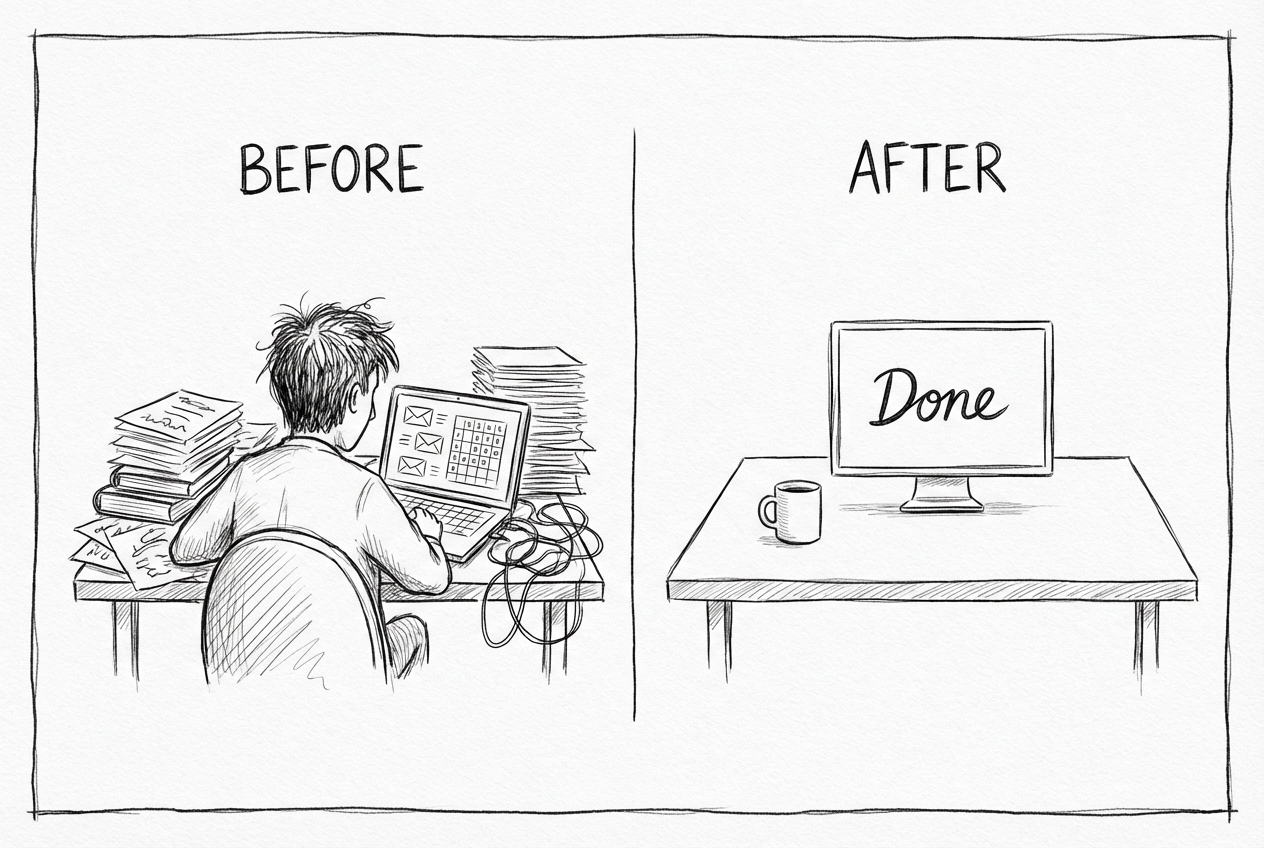
The situation: A precast concrete manufacturer in Western Canada, 20-40 employees. Supplier emails arrive daily containing product specifications. A full-time admin manually reads each email, extracts spec data, reformats into standardized spec sheets, and uploads to Jobber (their job management platform).
Time spent: 10 hours per week. Annual cost: approximately $25,000 in labor. Error rate: low (the admin was experienced) but inconsistent formatting across suppliers created downstream issues.
The change: An automated system was connected to the company's email and Jobber. Incoming supplier emails are read automatically. Product specifications are extracted, standardized into the correct format, and uploaded to Jobber.
Implementation was not a major IT project. No new infrastructure. No long timeline.
The numbers:
| Metric | Before | After |
|---|---|---|
| Processing time per email | 15-20 minutes | Seconds |
| Weekly hours on task | 10 | 0.5 |
| Annual cost | ~$25,000 | ~$6,000 |
| Net annual savings | ~$19,000 | |
| Formatting consistency | Variable | 100% |
| Admin capacity freed | 0 hours/week | 10 hours/week |
The less obvious ROI: The direct savings are clear. But the second-order effects are where the real value lives.
Those 10 hours per week were absorbed back into the business. The admin began handling customer escalations, vendor coordination, and process improvements. Work that had been deprioritized because "there wasn't time."
When you free up a capable person from mechanical work, you don't just save money. You unlock capacity you didn't know you were missing.
The takeaway: Before you hire your next admin, look at how your current team spends their time. If someone is spending hours moving information between systems, you're not looking at a staffing problem. You're looking at a process problem with a measurable price tag.